
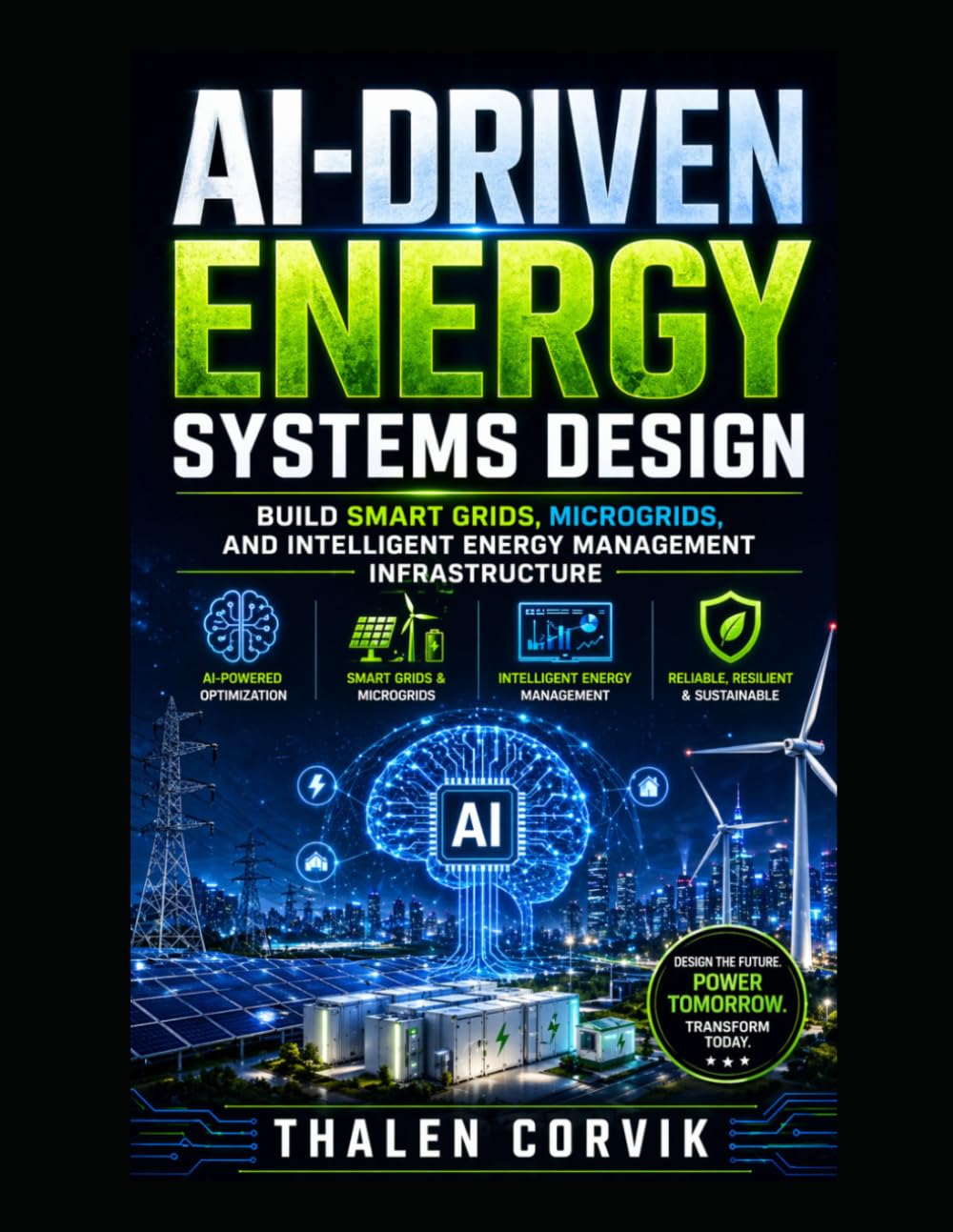
AI-Driven Energy Systems Design: Build Smart Grids, Microgrids, and Intelligent Energy Management Infrastructure
Product details
| Management number | 231977571 | Release Date | 2026/06/18 | List Price | $10.34 | Model Number | 231977571 | ||
|---|---|---|---|---|---|---|---|---|---|
| Category | |||||||||
Most books on AI and energy systems stop exactly where the hard problems start. They describe algorithms, present simulations, and report accuracy metrics — then leave you with no path from a trained model to a running grid controller. This book is built for engineers who are done waiting for the research to land in production.AI-Driven Energy Systems Design is a hands-on engineering guide to building AI systems that actually run on power grid hardware. Every chapter produces something you can run, test, and deploy — from data pipelines to RL agents to production monitoring. The book uses the GRID-AI Architecture framework (Data, Intelligence, Control, Operations) as a scaffold that runs through all 17 chapters, so every technique and tool has a defined place in a complete, deployable system.What you will learn and build:- Design AI-powered energy management systems for smart grids and microgrids using Python- Build load forecasting pipelines with LSTM networks and gradient-boosted trees on real grid data- Implement reinforcement learning agents for real-time grid dispatch optimization using Grid2Op- Configure grid topology models and sensor pipelines with Pandapower and OpenDSS- Apply demand response strategies with AI-driven appliance scheduling and MILP optimization- Design microgrid control hierarchies across primary, secondary, and tertiary control layers- Integrate renewable energy sources with AI optimization and battery storage dispatch- Detect grid faults and equipment anomalies with SHAP-explainable ML classifiers- Build peer-to-peer energy trading coordination using multi-agent AI frameworks and Mesa- Deploy scalable AI systems from simulation through hardware-in-the-loop validation to productionThe GRID-AI Architecture approach in this book means every chapter is grounded in a production system design rather than a standalone research experiment. Five verified real-world case studies — including Microsoft Research's West Atlanta microgrid RL deployment, the MISO/MIT load dispatch acceleration, and the ADNOC AI emissions reduction initiative — show what these techniques achieve at operational scale.For electrical engineers adding AI to their skill set, ML practitioners moving into the energy domain, and experienced grid engineers ready to deploy. If you are ready to build AI systems that run on real hardware and stay running, start with Chapter 1. Read more
| ASIN | B0H1L3XZJ5 |
|---|---|
| ISBN13 | 979-8196628740 |
| Language | English |
| Publisher | Independently published |
| Dimensions | 8.5 x 0.55 x 11 inches |
| Item Weight | 1.54 pounds |
| Print length | 240 pages |
| Publication date | May 12, 2026 |
Bestseller ranking
Neural Networks


Customers who viewed this product also viewed
Office Electronics


Correction of product information
If you notice any omissions or errors in the product information on this page, please use the correction request form below.
Correction Request Form